
Boat guide & comparison
A practical comparison between monohulls and catamarans: real costs, onboard space, fuel consumption, marina logistics, and the kind of experience you’ll actually have during your sailing holiday.
Let’s start from the dock: check-in is the moment of truth, when brochure dreams meet your credit card receipt.
Choosing between a monohull and a catamaran isn’t a matter of belief, but of physics and budget.
If you’re about to book your next sailing holiday, you need to know exactly what you’re paying for and which option truly fits your needs. Forget dockside opinions: this is a technical and financial breakdown for those who live the sea just one week a year.
When you look at charter prices for a week in August, the first number hits you like a wave: a 46-foot monohull, around 14 meters, like the Oceanis 46.1, typically costs between €4,500 and €5,500.
A catamaran with the same number of cabins, like the Lagoon 42, usually ranges between €9,000 and €11,000.
The real calculation
With the same number of guests, 8 people, you pay about €600 per person on a monohull, and around €1,200 on a catamaran.
In other words, you’re paying double to sleep in a cabin that is, technically, almost the same size.
So where does the extra money go? Into the saloon, the cockpit, and all the shared living areas, which on a monohull you only get by going significantly bigger.
Here are the numbers comparing two charter market benchmarks: Oceanis 46.1 and Lagoon 42.
| Living area | Monohull Oceanis 46.1 |
Catamaran Lagoon 42 |
Difference |
|---|---|---|---|
| Cockpit | ~11.0 sqm | ~15.0 sqm | +36% |
| Saloon / Dining area | ~12.5 sqm | ~16.0 sqm | +28% |
| Bow / sunbathing areas | ~4.5 sqm | ~22.0 sqm (including net area) | +388% |
| Total social area | ~28.0 sqm | ~53.0 sqm | +89% |
In the Mediterranean, space is a luxury. Mooring a catamaran in Sardinia or Croatia during high season often means accepting a real multiplier cost: in most marinas, you’ll pay +50% to +100% compared to a monohull.
The reason is simple: a 42-foot catamaran is about 7.70 meters wide, while a 46-foot monohull is around 4.50 meters. From a marina operator’s perspective, you’re taking up the space of two boats.
This doesn’t just mean paying more. In crowded marinas, catamarans also have to deal with a bulkier structure, mooring lines from nearby boats, and limited visibility from the raised helm. This is a big advantage when sailing, but requires more attention in tight docking situations.
And while a monohull might squeeze into the last available berth, a catamaran may need to stay at anchor. That said, thanks to its larger volumes, it often offers greater autonomy and a more comfortable onboard life.
Many people choose a catamaran expecting to fly over the water like PlayStation, the legendary multihull sailed by Steve Fossett. And if you’ve ever tried a Hobie Cat on the beach, you know exactly what that feels like: ultra-thin hulls and adrenaline-pumping speed.
But here’s the physics behind it. Ocean and beach catamarans are incredibly fast because they have very narrow hulls and are extremely lightweight. Without the heavy ballast keel that monohulls need to stay upright, they use their width to carry much more sail area.
In other words, they rely on form stability rather than weight stability. It’s like having an engine with far more horsepower: being wider and lighter at the same length, they can carry a much larger sail plan and convert even light wind into pure forward motion instead of heel.
Charter reality
The catamaran you rent for your holiday isn’t a lightweight racing machine. It’s built in solid fiberglass, with large cabins, spacious bathrooms, a comfortable saloon, and a much heavier structure designed to withstand torsion when sailing in waves.
To fit all of this, designers have to make the hulls wider. Modern designs try to optimise this, but the reality remains: much of the extra sail power is used to overcome weight and drag.
The result? In light wind, a monohull often glides more easily, with less surface in contact with the water, while the floating “penthouse” struggles more to break free from its own wake.
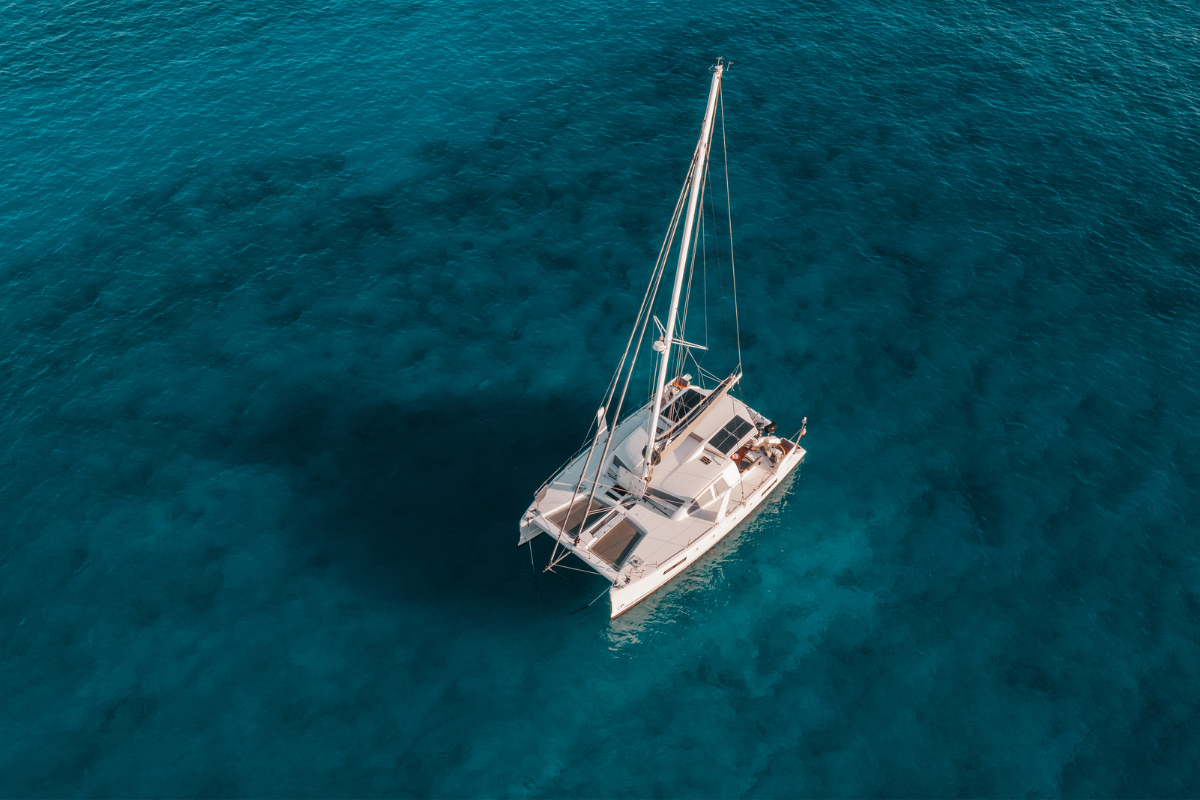
Physics is unforgiving: moving 12 tons of fibreglass that are 8 meters wide takes energy.
A monohull has a single point of resistance and propulsion: one hull, one engine. It’s agile and efficient at sea, but if you’re not confident with harbour manoeuvres, you may feel the need for a bow thruster when handling tight spaces or crosswinds.
A catamaran, on the other hand, behaves more like a small tank: thanks to its two engines set far apart, it can rotate almost on the spot by reversing thrust on one side.
A single 80 hp engine consumes around 5–6 litres per hour.
Over a typical week, fuel costs for a monohull are around €250.
On a catamaran, with two engines and greater hydrodynamic resistance, consumption can easily double, reaching around €500.
Source mentioned in the text: Yanmar / Volvo Penta technical data for charter engines.
This is where you truly decide what kind of holiday you want.
It’s an incredibly stable platform. Ideal for families with children or for anyone who wants to enjoy aperitifs and social moments even while sailing, without dealing with the heel.
Thanks to its large technical volumes, it offers great autonomy: watermakers and batteries allow you to stay at anchor for days without needing to return to shore.
With a shallow draft of around 1.20 meters, it can anchor in shallower waters, always respecting local regulations.
The dinghy, usually stored on the aft platform or on davits, is out of the way and makes launching and hauling effortless.
For pure sailing. For the direct connection with wind and sea. For those who want to learn or truly feel the art of sailing.
A monohull “talks” to you: it heels, reacts, and gives you immediate feedback at the helm.
On a catamaran, precisely because it doesn’t heel, it’s harder to perceive changes in wind strength, especially for less experienced sailors and on downwind courses.
It’s also true that handling the dinghy manually, often stored on deck, is less practical and requires more space and physical effort. But for true sailing enthusiasts, the agility at sea is worth it.
In summary
A catamaran costs more, takes up more space, and consumes more, but gives you comfort, stability, and room to live.
A monohull is leaner, more affordable, and more authentic for those who want to truly feel sailing.
The real question isn’t which boat is better. It’s this: do you want a floating apartment or a pure sailing experience?
Article by Giacomo Giulietti at LLiquida – Marketing & Communication for the Marine Industry

€ 4,040
price of the whole boat

€ 2,240
price of the whole boat

€ 1,575
price of the whole boat

€ 5,625
price of the whole boat

€ 5,040
price of the whole boat

€ 3,150
price of the whole boat

€ 1,655
price of the whole boat

€ 1,274
price of the whole boat
Our regular email newsletters include information about our boats, holiday ideas, destination insights and cultural briefings. You can unsubscribe at any time and we'll treat your data with respect, never passing on your details to third parties. Find full details of our data management in our Privacy policy page
By signing up, I agree to Sailogy's T&C's and Privacy policy

Looking for inspiration for your next sailing holiday? Packed with insights on trending sailing destinations plus stories from expert sailors and first-timers, our brand new digital magazine - Magister Navis - will guide your way to your next sail.
View magazine

